Community comes in many forms
Over the weekend I was lucky enough to attend an Epilepsy Wellness Conference. I got home and realized I hadn’t taken a single picture, I was so in the moment-a sure sign I’ve had a great time at an event.
Since my diagnosis I’ve been part of a couple different support groups and even a class on how to thrive with my condition, but they were all online. Going in I was so excited to see everyone I had already connected with, I hadn’t fully considered how impactful being surrounded by people with epilepsy would be.
I doodled while I listened to the speakers; keeping my hands busy helps the rest of me focus. I’m so used to being around artists (who rarely bat an eye at your doodling as they’re busy doing their own) that it sometimes surprises me when it catches the attention of others.
Having this realization made me wonder if there will ever be a time I’m so connected with my epilepsy community that it will no longer feel as profound to be so surrounded in this way. Will it get to the point where it feels strange to exist in spaces without a baseline understanding of my disorder?
I think I’d actually welcome that last one. . .
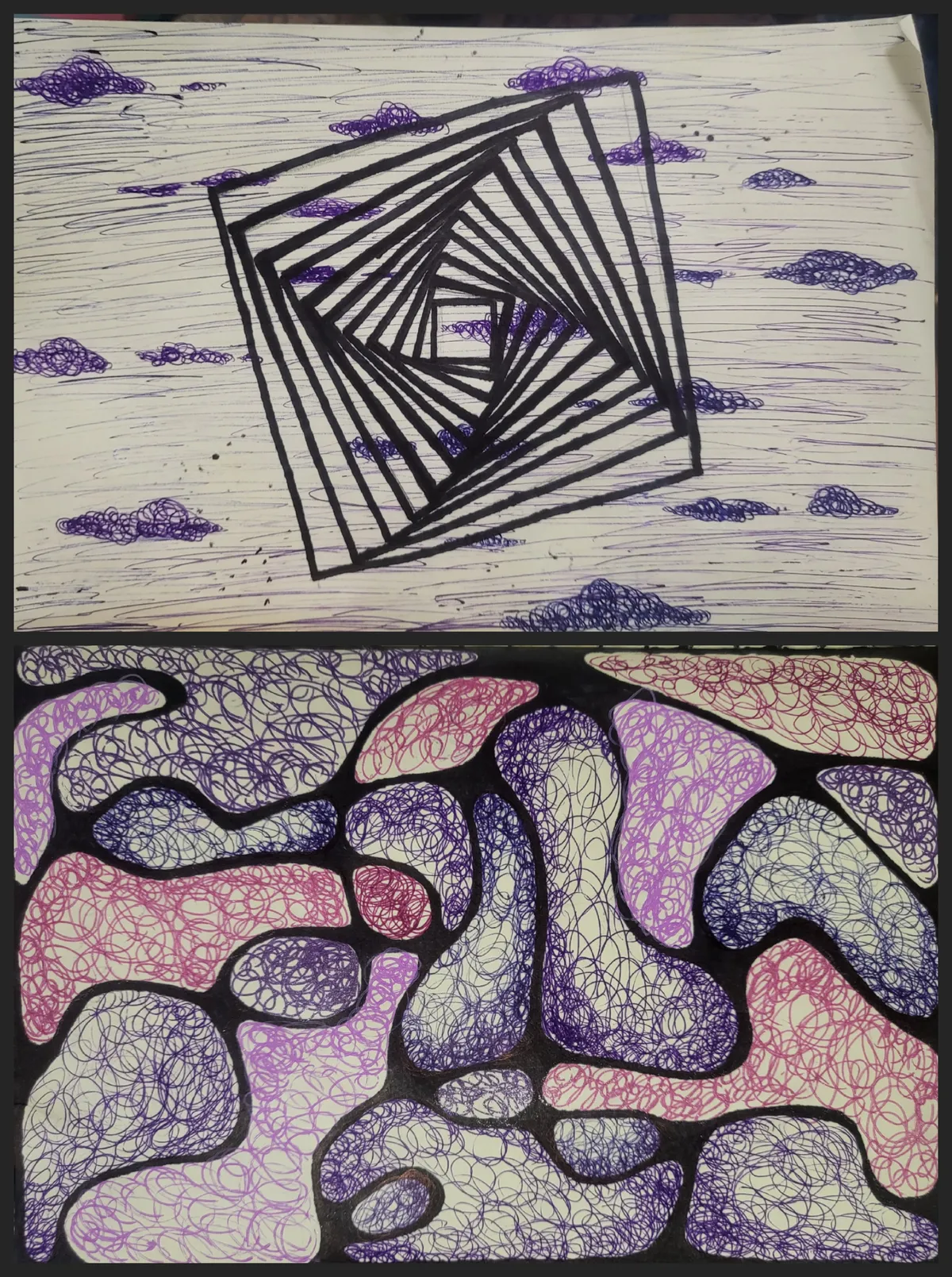
Purple sketches for Epilepsy Awareness Month!
In addition to the doodles, I tried to jot down some of the most impactful insights:
- About 2/3 of People with Epilepsy (PWE) achieve seizure freedom1 through medication alone, but there are also several surgeries with high success rates of seizure freedom
- Neurocognitive Domains: a neuroscientist at the conference explained part of why epilepsy is so complicated is because two people having the same “type” of seizure may have different parts of the brain affected. There are five neurocognitive domains: Language, Learning/Memory, Social Cognition, Perceptual Motor Function, and Executive Function. Any given PWE may have a combination of different domains affected, in addition to the fact that within each domain there is a high level of variation in symptoms.
- Many people (with epilepsy, but let’s be honest, in general) experience both enacted and felt stigma. This means they both see themselves being treated differently in real time, and also experiencing anxiety because of internalized feelings.
- Epilepsy has a high comorbidity with social phobia. This should have been obvious to me but for some reason wasn’t, even though I was experiencing it. Managing your own personal epilepsy effectively can be rigorous; there are a lot of variables out in the wild that can be triggering, like stress, cigarette smoke, or photo strobe. The combination of these factors can make a PWE hesitant to return to normal social functions when they receive their diagnosis.
- At the conference, I learned about a great framework for creating effective action plans called SMART choices. Basically, when you set a goal you want to make sure it is Specific, Measurable, Achievable, Relevant, and Time-Bound. You can’t demand the world of yourself and expect to ever feel accomplished!
What I learned more than anything else is that we need each other as fellow humans. Community comes in many forms, from your neighborhood to coworkers to people with the same hobby, interest, or disability as you. Each of us belongs to many communities. While art is perhaps one of the most universal communities, it’s too easy for it to become as narrow as your local scene. There’s also something to be said for the fact that artists are perhaps more congruent in being similarly minded - certainly moreso than the entirety of the epilepsy community. We are as diverse as the condition itself, and that has both challenged and fulfilled me in ways that feel very critical.
November is Epilepsy Awareness Month!
Did you know 1 in 26 individuals will be affected by epilepsy in their lives? This month I’ll be posting about my personal journey with epilepsy as well as some general info to help start the conversation! You can also learn about the basics here from The Epilepsy Foundation.
"Seizure freedom" is difficult to define even within the epilepsy community, but roughly means the person has been seizure free for a significant time. This graphic breaks the term down and why it's so hard to accurately report.↩